Thursday, December 31, 2020

Pasir Ris Park (Dec 2020)

 I'll resurrect this blog with a selection of butterflies spotted at Pasir Ris Park over a couple of days this December. Pasir Ris Park is really a rather good place to encounter some of the commoner species of butterflies (as well as some less common ones dependent on the mangroves), and the casual butterfly observer will almost always not leave empty-handed. 


The Plain Tiger (Danaus chrysippus chrysippus), is almost always sure to be found fluttering around the Blood Flower plants at the butterfly corner within the park.

The Blue Glassy Tiger (Ideopsis vulgaris macrina) is also another resident butterfly at the park. These 'tiger' butterflies, along with the Dark Glassy Tiger, are not difficult to observe and photograph as they fly languidly amongst the flowers, taking their time to feed at each flower head.


The Cycad Blue (Chilades pandava pandava) is another lovely little butterfly that is commonly encountered there. This particular individual was deeply engrossed in its nectar drink and offered opportunities for many pleasing 'grey on grey on grey' photographs.

The Peacock Pansy (Junonia almana javana) is a cheerful butterfly which is also regularly encountered at the park. This butterfly has beautiful eyespots on its hindwings.

Finally, a Blue Nawab (Polyura schreiber tisamenus), one of the less common butterflies that can occasionally be found within the mangrove forest. This butterfly is a challenge to photograph as it is a very strong and fast flyer, and somewhat restless and alert.

Tuesday, December 29, 2020

More to come...

 It's time to resurrect this blog. Stay tuned!

Thursday, November 26, 2015

Common Palmfly (Elymnias hypermnestra)

Recently a Common Palmfly caterpillar pupated on one of my palm plants, with the adult butterfly emerging just a few days back. Just a few pictures I snapped of the chrysalis and the butterfly.

Dorsal view of the chrysalis. It is coloured a lovely bright green with yellow lines edged in red and blends in surprisingly well with the palm leaves. The chrysalis is attached to the underside of the palm leaf.

Side view of the chrysalis. This was just a day before the butterfly emerged. The wings and eyes of the butterfly are clearly visible but have not yet taken on any colour.
Side view
The adult Common Palmfly hanging from its empty pupal case while its wings dry. The undersides are coloured a rich reddish brown and heavily streaked.

Wednesday, June 17, 2015

At Tampines Eco Green


Although the sky was overcast and there were intermittent drizzles, many butterflies were visible, as were other invertebrates and birds. Below are some shots of the critters I encountered.

First up, a Mottled Emigrant (Catopsilia pyranthe) caterpillar on its host plant, Senna alata, also known as Seven Golden Candlesticks. There were caterpillars of various instars on the plant, although I did not notice and adult Mottled Emigrants.


A hapless Lesser Grass Blue (Zizina otis lampa) impaled on the fangs of a crab spider
A garishly coloured and undoubtedly toxic White-Marked Tussock Moth (Orgyia leucostigma) caterpillar lying in full view and enjoying a late lunch
A Ciliate Blue (Anthene emolus goberus) feeding on Leea rubra blooms. It appeared very contented and quite lethargic.
A Bush Hopper (Ampittia dioscorides camertes) basking on a leaf. These are small butterflies which 'skip' around amongst tall blades of grass.
More Bush Hoppers
Another Bush Hopper
The underside of the Bush Hopper
Most likely a Yellow Grass Dart (Taractrocera archias quinta). No hook at the end of the antennae unlike the Lesser Dart.
A Tawny Coster (Acraea violae) feeling on the blooms of Mikania micrantha. Lots of these butterflies fluttering around  the park.


The undoubted highlight of the trip, the Long-banded Silverline (Spindasis lohita senama). This particular individual was looked remarkably pristine. The underside of the Long-banded Silverline is strikingly and quite whimsically marked. There were a few of these butterflies around a particular Leea rubra bush, and they kept returning to their favourite perches.


Long-banded Silverline


Long-banded Silverline


A more fortunate Lesser Grass Blue (Zizina otis lampa) perched on a blade of grass.


Wednesday, November 27, 2013

Common Grass Yellow

The very common Common Grass Yellow (Eurema hecabe contubernalis). Its commonness takes nothing away from its charm; this cheerful little creature almost perfectly embodies the word 'butterfly'. There can be few pleasanter sights than one or a few of these butterflies fluttering amongst colourful blooms in bright sunlight.

Tuesday, November 26, 2013

Another Eupanacra elegantulus caterpillar

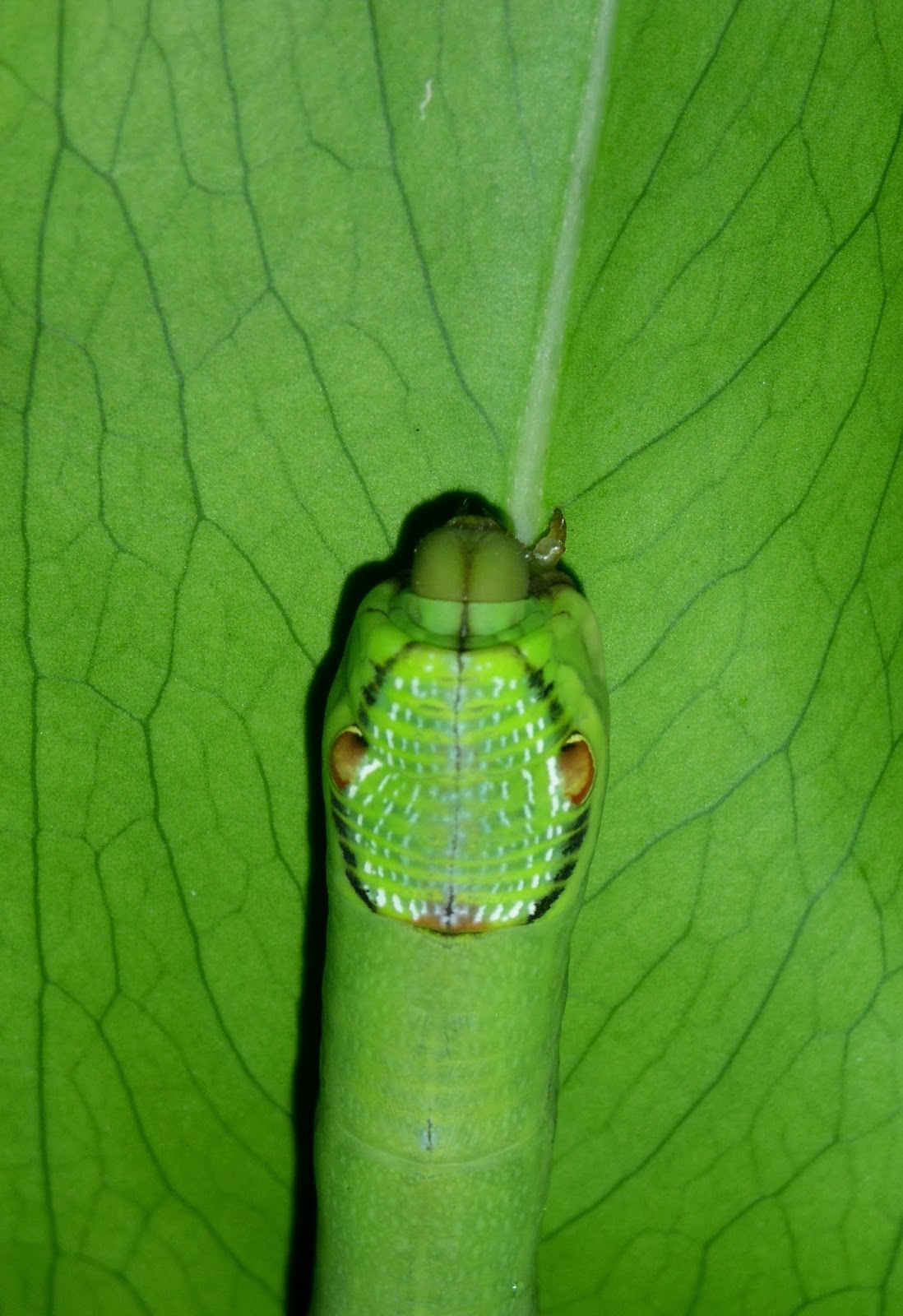
The green form of the caterpillar of the Eupanacra elegantulus hawkmoth on Monstera deliciosa. Spectacularly big (4 inches long), spectacularly beautiful and surprisingly hard to spot.


Thursday, November 7, 2013

Eupanacra elegantulus caterpillar

A few shots of a beautiful, full-grown caterpillar of the hawkmoth Eupanacra elegantulus, found on Monstera deliciosa. The first four photos show the caterpillar assuming a threat posture mimicking a snake to ward off would-be predators. The final photo is a close up of the caterpillar's thorax with its startling eyespots.


Wednesday, July 10, 2013

Common Palmfly (Elymnias hypermnestra)

A Common Palmfly, Elymnias hypermnestra, feeding on a torch ginger flower. At the Singapore Botanic Gardens.

Another Common Palmfly resting on foliage in shade. The Common Palmfly, perhaps unusually for a butterfly, prefers to fly in shaded areas.

Another individual resting on an aerial tree root.

Friday, December 30, 2011

Pale Grass Blue (Zizeeria maha serica)

Pale Grass Blue, Zizeeria maha serica. The Pale Grass Blue is a member of the Lycaenidae butterfly family and sports a typical lycaenid colouration and pattern. The upperside of the male, as seen in this individual, is a pale blue with broad black-blue borders. The underside is a silvery grey with a pattern of black spots concentrated on the outer margins of the wings. The Pale Grass Blue can be found in grassy areas where it flutters near to the ground and amongst low-growing flowering plants.

Life Cycle of the Blue Glassy Tiger (Ideopsis vulgaris macrina)

The Blue Glassy Tiger, Ideopsis vulgaris macrina, is a common butterfly in Singapore. Individuals can often be encountered fluttering languidly amongst flowering shrubs. Like other Danaids, the Blue Glassy Tiger is distasteful to potential predators because of toxins derived from plants the caterpillars and adults feed on.

The egg of the Blue Glassy Tiger is a pale yellow and slightly elongated and is usually attached to the underside of the leaves of its host plant.


The young caterpillar is similarly coloured as caterpillars of later instars. The caterpillars are smooth with two pairs of tubercles, one at either end of its body. The caterpillar is a dark reddish purple with a dense pattern of white spots. the head of the caterpillar is a shiny black and the tubercles are a pinkish red with black tips.

The caterpillars feed voraciously (like all other caterpillars haha) and grow rapidly.

The pupa is a beautiful bright green with a few black spots, as well as three highly reflective silver spots. These spots, with their possible resemblance to leaf holes or water droplets, probably help to camouflage the pupa. The pupa is usually suspended from the underside of a leaf of the host plant.


The adult Blue Glassy Tiger is a simply patterned but beautiful butterfly. On the upperside, the wings are a dark brown streaked and dotted with a lovely pale blue. The underside is similar but paler in colour. The butterflies are very fond of Heliotropium indicum.

Thursday, July 21, 2011

Grey Pansy and Chocolate Pansy

The Grey Pansy, Junonia atlites atlites. At MacRitchie Reservoir. Possibly the rarest of the pansies in Singapore, and, maybe, the most exquisitely coloured and patterned one. Typical flitting flight of pansies.

The Chocolate Pansy, Junonia hedonia ida. The commonest of the pansies. A few individuals can often be found in sunny clearings chasing each other and basking. Loves bright sunlight, often rests with wings outspread.


Faded Chocolate Pansy. Alexandra Hospital.


Chocolate Pansy on Lantana. Singapore Botanic Gardens.